
Helping kids make career choices starts early. Teach your mini millionaire to find the overlap between passion, skill, values and what pays
Most career conversations with kids start with: "So what do you want to be when you grow up?"
And while it's a well-meaning question, it only really touches on one piece of a much bigger puzzle.
The thing is though, that there’s a sweet spot, when someone’s career actually becomes fulfilling, that sits at the overlap of four things:
Most kids only ever really get asked about the first one. So this week, we're helping you bring all four into the conversation with your mini millionaire.
And with South African youth unemployment sitting above 46%, helping kids find genuine direction early has never mattered more.
Every job is just a problem that needs to be solved.
Are you hungry? Well, the farmer grows our food, the baker turns it into bread, and the chef cooks up a delicious meal. If you’re sick? No problem, that’s what a doctor is there for.
See, when we reframe careers as problem-solving, there’s a shift that happens.
It opens up career doors they didn't even know existed. A recent study found that 68% of adults work in jobs they didn't even know existed as children.
Think animators, sound engineers, urban planners, even marine biologists. Career paths your child may never have seen up close, but that are very real, very paid, and very possible.
Takeaway: Help your child see that every career starts with a problem worth solving.
Make career curiosity a normal conversation.
Swap "what do you want to be?" for questions that actually get somewhere. Questions like "what have you done lately that didn't feel like hard work, even though it kind of was?" or "what would you do all day if no one was watching?"
Keep it light, keep it ongoing. And tweak it a little according to your child’s age:
Ages 5 - 8: Celebrate every answer, no matter how wild. If they want to be a dragon tamer, ask what skills a dragon tamer would need. Curiosity is the whole point right now.
Ages 9 - 12: Watch for the identity labels forming. Things like "I'm not a maths person," "I'm not creative" and gently push back as skills are learnable.
Ages 13 - 17: Help them hold two things at once. What excites them, and what the real world looks like. Looking up actual salaries and career paths together (like what to study, where to get their first job) isn't a dream-killer. It's part of making a real decision.
Takeaway: Keep the career conversation going long enough for your mini millionaire to find the answer themselves.
Turn your next errand run into a career lesson.
The next time you’re out with your mini millionaire, play a little game called the Job Safari.
Spot every job you can: The security guard, the person fixing a robot, the Barista making your morning coffee, even someone sitting in the corner having a meeting.
For each one, ask your child: "What problem does that person solve?" It sounds simple, but it gently rewires how they see the world: From just seeing people doing tasks, to people adding value to their world.
Bonus round: Ask them which job they'd most want to try for a day.
Takeaway: Career awareness just needs open eyes and curious questions.
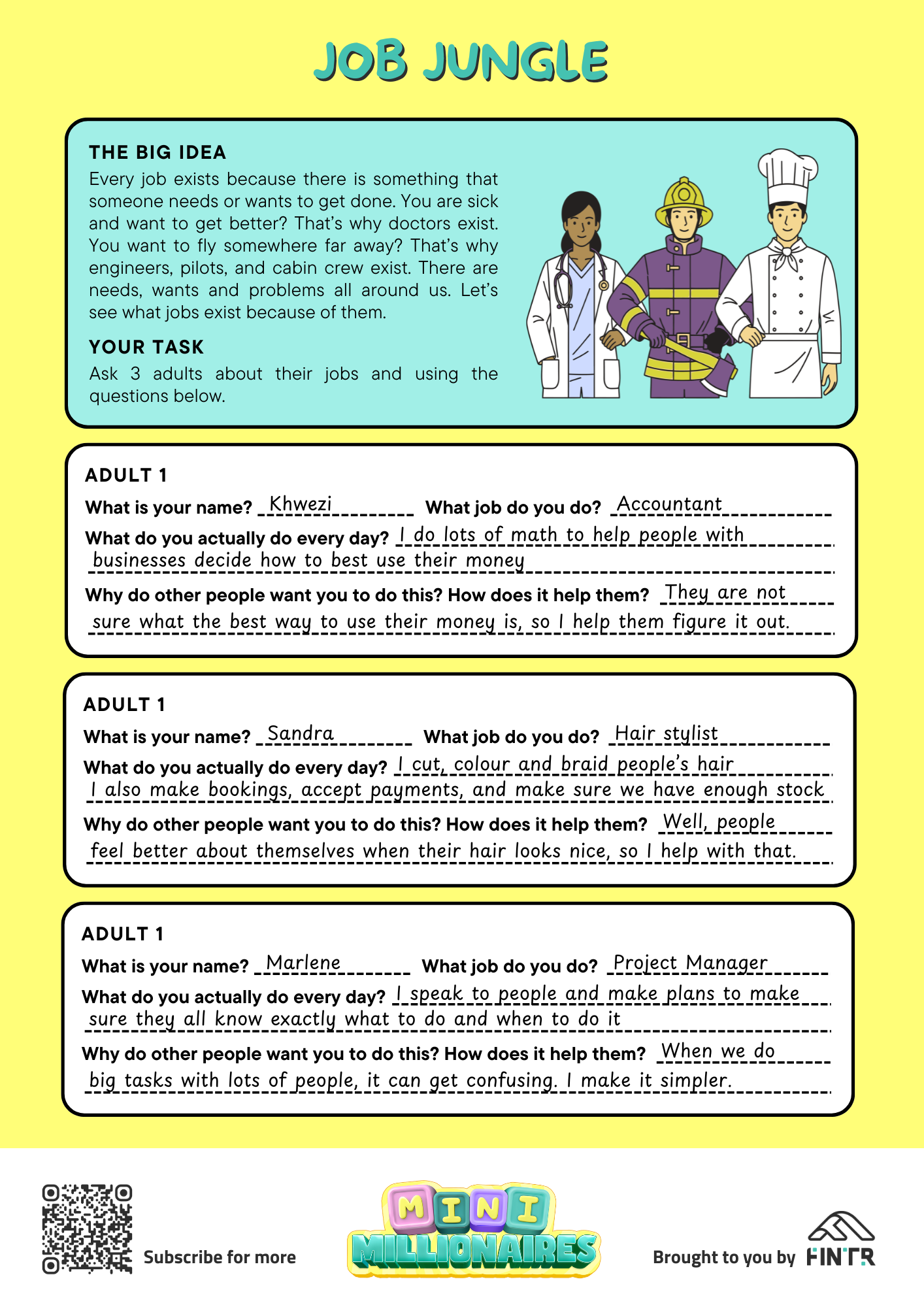
Every job exists because someone needed something done. Job Jungle is a fun printable activity that gets your mini millionaire interviewing three adults about their jobs to find out what they actually do every day, and why people need them to do it.
It's the Job Safari on paper. Perfect for sparking real conversations, broadening their world, and helping land the idea that every career is just a problem waiting to be solved.
Download it, print it out, and let their job exploration begin.